
Cutting-edge research is not only about discovery. It is also about finding compelling ways to share ideas, spark curiosity and connect with the wider community. That creativity was on full display in the inaugural ARC Centres of Excellence Creative Communication Competition, with GETCO2 researchers taking home two major awards.
Held as part of National Science Week 2026 (15-23 August), the competition celebrated researchers who are advancing world-leading research while finding innovative ways to communicate its impact through visual art, storytelling, video and other creative formats. GETCO2 researchers submitted four entries to the competition. Two of those entries received top honours, including first prize in the Digital Artwork category and the People’s Choice Award.
First prize for visualising the invisible
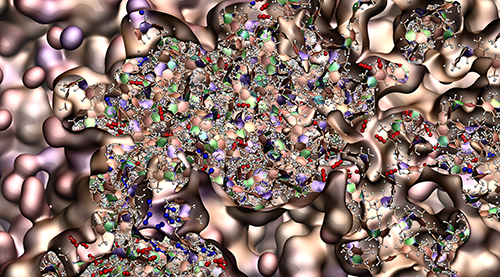
PhD student Shweta Dagar (The University of Queensland) was awarded first prize in the Digital Artwork category for her entry, Where the Human Eye Reaches Its Limit, Simulations Unveil the Unseen Molecular World.
Created using VMD software, the artwork presents the output of a computational gas adsorption simulation, revealing molecular-level interactions between an artificial polymeric membrane and gas molecules. In the visualisation, carbon dioxide (CO₂) molecules are shown in red and nitrogen (N₂) molecules in blue. The image demonstrates how CO₂ molecules preferentially occupy pockets within the polymer membrane compared with N₂ molecules, providing valuable insights into selective carbon capture processes and the development of direct air capture technologies.
No AI was used in the creation of the artwork.
People’s Choice Award for a cleaner future
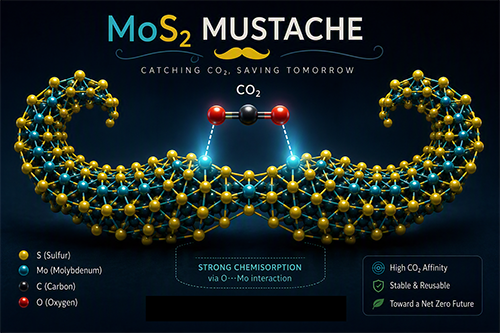
GETCO2 also claimed the People’s Choice Award, with PhD student Farhad Keivanimehr (The University of Queensland) recognised for his digital artwork Mustache for a Cleaner Future.
The scientific illustration depicts a CO₂ molecule selectively adsorbed at the central active site of a moustache-shaped molybdenum disulfide (MoS₂) nanomaterial. The artwork highlights the role of engineered catalytic sites in enabling efficient carbon capture and supporting sustainable climate solutions. The design and visualisation were created by Farhad using VESTA software and his own scientific data and modelling work. ChatGPT was used to assist with editing and refining the accompanying description, while the original artwork, concept and scientific visualisation were entirely researcher-created.
The People’s Choice Award reflected strong public engagement with the competition, with 2,274 votes cast across all entries.
Celebrating the art of research
In addition to the two award-winning entries, GETCO2 researchers submitted two other creative works that showcased the beauty and complexity of carbon capture research.
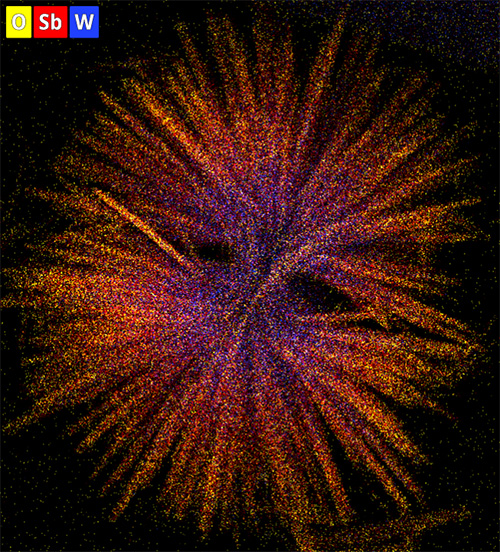
Chemical Fireworks: Revealing the Hidden Art within Sb₂WO₆ Crystals
At first glance, this striking image created by Fangzhou Liu resembles a firework display bursting across a night sky. In fact, it is an Energy-Dispersive X-ray Spectroscopy (EDX) map of an antimony tungstate (Sb₂WO₆) crystal, captured using a Thermo Fisher Spectra 300 microscope. By assigning colours to each element’s unique X-ray signature, yellow for oxygen, red for antimony and blue for tungsten, the image reveals how these atomic building blocks are distributed throughout the crystal. The overlapping colours create vibrant oranges and purples that highlight the material’s intricate nanoscale structure, demonstrating how scientific imaging can uncover unexpected beauty in the atomic world.
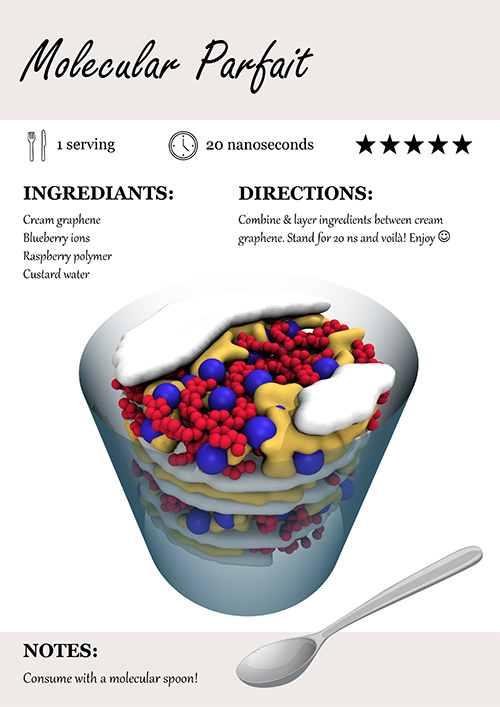
Molecular Parfait
Created using Visual Molecular Dynamics and PowerPoint, Molecular Parfait by PhD student Tanika Duivenvoorden transforms complex membrane science into a colourful dessert-inspired illustration.
The artwork depicts a layered membrane composed of polymers, ions, water and graphene sheets, visualised as layers of berries, custard and cream. Based on a molecular dynamics simulation run over 20 nanoseconds, the image illustrates the membrane in its equilibrium state and helps researchers understand how the different components interact. The creative analogy highlights the important role computational methods play in understanding membrane nanostructures for electrochemical applications. No AI was used in the creation of the artwork.
Showcasing creativity in research communication
Open to researchers and members from nine participating ARC Centres of Excellence, the competition invited entrants to communicate their own research, or that of their laboratory or Centre, through six creative categories:
- Photography/Microscopy
- Digital Artwork
- Drawing, Painting and Sculpture
- Memes
- One-Minute Videos
- Graphic Novels, Comics and Zines
The competition highlighted the many ways researchers can communicate complex ideas, demonstrating that impactful research engagement can take many forms, from artistic interpretation and visual storytelling to short-form video and creative narratives.
Entries were assessed by an expert judging panel comprising:
- Bonnie Johnson, Director, Communications and Engagement, Australian Research Council
- Associate Professor Jen Martin, Leader of the Science Communication Teaching Program and Academic Lead for Graduate Research, University of Melbourne
- Alicia Sometimes, Australian writer, poet and broadcaster
Judges considered creativity, originality, visual impact and the effectiveness of research communication.
The ARC Creative Communication Competition was a collaboration between the ARC Centres of Excellence for Automated Decision-Making and Society (ADM+S), 21st Century Weather, Innovations in Peptide and Protein Science, OzGrav, Plants for Space, Dark Matter, Plant Success in Nature and Agriculture, Synthetic Biology, and GETCO2.
View all winning entries on scienceart.com.au